Knitted Flowers: A Seamless Vector Pattern for Textile, Craft, and Print Design
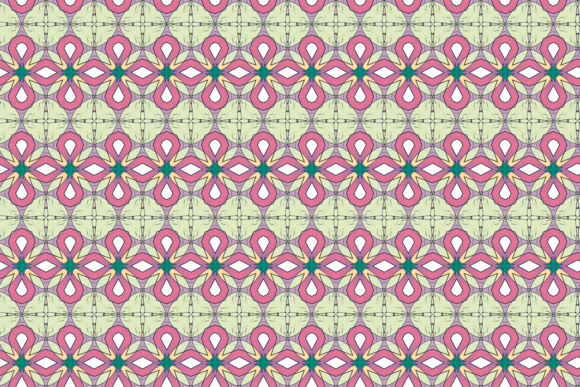
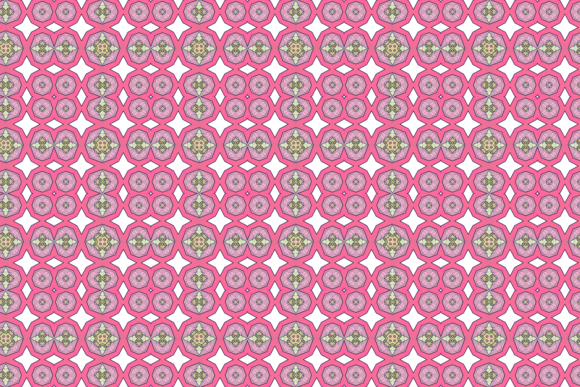
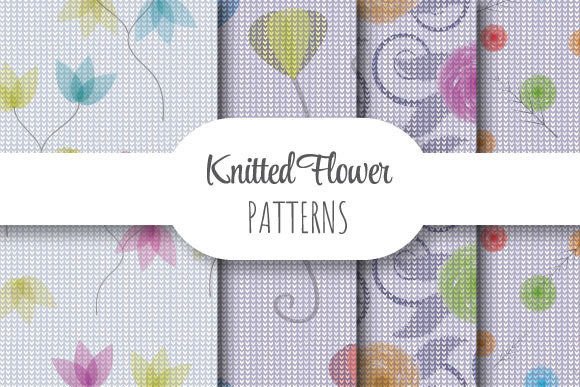
Knitted Flowers refers to a curated vector pattern collection designed specifically for applications where texture, repetition, and resolution integrity matter—especially in textile design, surface pattern work, stationery, and high-fidelity print production. Unlike raster-based floral motifs or hand-drawn scans, Knitted Flowers is built as a seamless, tileable vector pattern in EPS 10 format, with each tile precisely sized at 12 × 12 inches (3600 × 3600 pixels at 300 dpi). The package includes one editable EPS file and four high-resolution JPEG previews—offering both flexibility in editing and immediate usability across platforms.
What Makes Knitted Flowers Distinctive?
The term “knitted” here isn’t literal—it evokes the rhythmic, interlaced quality of knit stitch structure translated into botanical form. Each flower element repeats without visible seams or alignment artifacts, thanks to precise anchor point placement and balanced negative space. This isn’t just a floral border or isolated motif; it’s a fully tessellated pattern optimized for infinite tiling in Adobe Illustrator, Affinity Designer, or any vector-compatible workflow.
At 300 dpi and 3600 × 3600 pixels, the included JPEGs serve as accurate visual references—not just placeholders—but they’re not intended for direct print use. The EPS file retains full scalability, layer organization, and color separation readiness, making it suitable for screen printing separations, embroidery digitizing prep, or packaging mockups where clean paths and Pantone-ready swatches matter.
How It Compares to Other Floral Pattern Options
Many designers encounter floral patterns in three broad categories: scanned textures, hand-illustrated motifs, and algorithmically generated repeats. Knitted Flowers sits between the second and third—hand-crafted in intention but engineered for technical precision.
- Scanned or photographed textures offer organic grain and realism but lack scalability and seamlessness without significant manual cleanup. They rarely tile cleanly at large scales and often introduce compression artifacts or color shifts when resized.
- Isolated vector flowers (e.g., single blooms on transparent backgrounds) give maximum editing freedom but require time-consuming arrangement, spacing, and repeat construction—especially for consistent density and rhythm across large surfaces.
- Generative or AI-assisted repeats can produce novelty quickly but often lack intentional hierarchy, consistent stroke weight, or deliberate negative space—qualities essential for legibility at small scales (like fabric swatches or gift wrap).
Knitted Flowers avoids those tradeoffs by delivering a ready-to-use, mathematically aligned repeat that preserves craft-like nuance while meeting production-grade requirements.
Fitness for Purpose: Where Knitted Flowers Excels
Knitted Flowers works best when your project demands both aesthetic cohesion and technical reliability. Consider it ideal for:
- Textile designers creating fabric collections for digital printing—especially cotton voile, linen, or silk, where subtle texture and even distribution affect drape and visual weight.
- Packaging developers applying background patterns to boxes, labels, or tissue paper where seamless continuity across folds and edges is non-negotiable.
- Stationery creators producing wedding suites, greeting cards, or notebook covers that balance delicacy with reproducibility across offset and inkjet runs.
- Surface pattern students or educators studying repeat construction principles—how half-drop, brick, or mirror layouts behave in practice—without starting from scratch.
In each case, the 12 × 12 inch tile size provides enough visual complexity to avoid monotony, yet remains manageable for previewing and testing at multiple scales—from thumbnail web views to full-wall murals.
Tradeoffs and Practical Limitations
No pattern solution fits every context—and Knitted Flowers has boundaries worth acknowledging.
It is not a multi-color variant pack. The EPS file contains one cohesive color scheme—designed for versatility but not built for instant palette swapping. While swatches are organized and named, changing hues across dozens of interlocking elements requires manual selection or global recoloring tools. Designers needing rapid A/B color testing may prefer layered PSD files or SVG collections with CSS-ready classes.
It is also not optimized for animation or interactive media. The EPS format doesn’t support transparency blending modes or frame-based sequencing—so it won’t suit web banners requiring parallax or hover effects. For those uses, a well-exported SVG or Lottie version would be more appropriate, though that would require conversion outside the delivered assets.
Additionally, while the JPEG previews are sharp, they reflect only one interpretation—the default color build. If your output device or substrate alters perceived saturation (e.g., uncoated paper dulling pastels), soft-proofing against the EPS is advisable before final output.
When You Might Choose Something Else
Knitted Flowers shines in controlled, print-forward environments—but other scenarios call for different tools.
If you’re developing for app interfaces or responsive websites, scalable SVGs with semantic grouping and accessible contrast ratios may be more maintainable than EPS-based workflows. Similarly, if your goal is embroidery digitizing, you’ll likely need stitch-specific files (e.g., .dst or .pes) rather than vector outlines—though Knitted Flowers’ clean paths can serve as excellent base art for conversion.
For large-scale murals or architectural wraps, some designers prefer patterns built at 1:1 scale in native document size (e.g., 48 × 96 inches) to minimize interpolation during scaling. Knitted Flowers’ 12 × 12 inch tile is standard, but not oversized—so very tall vertical repeats may require careful planning to avoid noticeable repetition frequency.
And if your work prioritizes customization depth over speed—such as adjusting petal count per bloom, varying stem thickness by row, or introducing randomized rotation—you may find parametric tools like Illustrator’s Pattern Options or dedicated generative software more adaptable long-term.
Making an Informed Choice
Evaluating Knitted Flowers isn’t about whether it’s “the best floral pattern”—it’s about whether its specific balance of craft sensibility, technical precision, and delivery format aligns with your current project’s constraints and goals.
Ask yourself:
- Do I need this pattern to tile seamlessly across variable dimensions—without manual intervention or visible breaks?
- Will it be used primarily in vector-based production (e.g., screen printing, laser cutting, or vinyl plotting)?
- Is resolution fidelity at 300 dpi critical for my output medium—or am I working mostly for web or social previews?
- Do I value having a single, production-ready EPS file alongside reference JPEGs—or would I benefit more from layered source files (e.g., AI or PSD) for granular edits?
Answering “yes” to the first two strongly signals Knitted Flowers as a fit. Answering “no” to the third or fourth doesn’t disqualify it—but may indicate supplementary assets would be needed alongside it.
Real-world examples help ground these decisions. A small-batch apparel brand launching a spring capsule used Knitted Flowers to unify scarf prints, garment linings, and hang tags—reducing asset management overhead while keeping visual continuity across touchpoints. Conversely, a freelance illustrator building a custom greeting card line opted for individual vector blooms instead, so she could rearrange compositions per sentiment and adjust proportions for die-cut windows.
Neither choice was wrong. Both reflected intentional alignment between creative intent and technical execution.
Final Considerations Before Use
Before importing Knitted Flowers into your workflow, verify compatibility with your software version—EPS 10 is widely supported, but legacy versions of CorelDRAW or older Illustrator releases may require fallback PDF export. Also, check color mode: the file is typically delivered in CMYK for print readiness, but RGB conversion is straightforward if needed for digital-only contexts.
Lastly, remember that pattern perception shifts with scale. What reads as delicate at 12 × 12 inches may feel dense on a 4 × 4 inch business card—or sparse on a 60-inch tablecloth. Always test at actual output size, not just zoomed canvas view.
Knitted Flowers doesn’t replace design judgment—it supports it. When your priority is a harmonious, repeatable, production-savvy floral foundation—not novelty for novelty’s sake—it offers quiet competence over flash. And in professional design work, that kind of reliability is rarely overrated.