Mosaic Flowers: Seamless Vector Patterns for Designers, Printers, and Creative Professionals
Whether you're designing stationery, textile prints, packaging, or digital backdrops, mosaic flowers offer a timeless fusion of botanical charm and geometric precision. But what makes these patterns truly valuable—and why do professionals specifically seek out seamlessly repeating vector patterns in high-resolution, production-ready formats? Let’s explore how mosaic flower designs function, why their technical specifications matter, and how they empower creativity across industries.
What Are Mosaic Flowers—and Why “Seamless” Matters
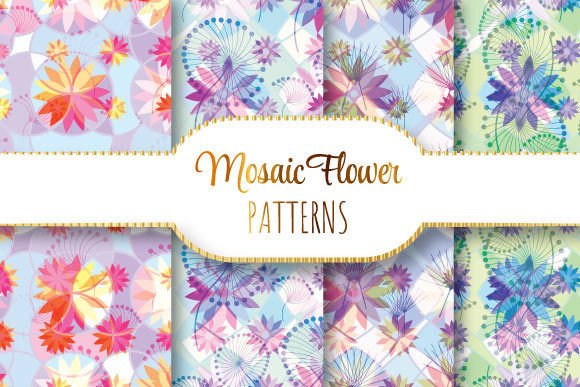
Mosaic flowers refer to stylized floral arrangements composed of interlocking, tile-like shapes—petals, leaves, or abstract botanical forms—that fit together like pieces of a puzzle. Unlike realistic illustrations, mosaic florals prioritize rhythm, symmetry, and repetition, making them ideal for surface pattern design.
The term “seamlessly repeating” describes a critical technical feature: when tiled side-by-side or top-to-bottom, the pattern aligns perfectly with no visible gaps, overlaps, or misaligned edges. This isn’t just an aesthetic preference—it’s a functional requirement. A non-seamless pattern creates jarring breaks in wallpaper, fabric rolls, or web backgrounds, undermining professionalism and usability.
Think of it like laying ceramic tiles on a bathroom wall: if each tile doesn’t match its neighbor at the grout line, the entire installation looks amateurish. In digital design, that “grout line” is the invisible seam between pattern repeats—and seamless vectors eliminate it entirely.
Why 12 × 12 Inches, 3600 × 3600 Pixels, and 300 DPI?
The stated dimensions—12 × 12 inches at 3600 × 3600 pixels, 300 DPI—are not arbitrary. They reflect industry standards for high-fidelity print production:
- 12 × 12 inches is the standard tile size for scalable surface pattern workflows. It provides enough visual complexity to feel rich and detailed, yet remains manageable for editing and rendering.
- 3600 × 3600 pixels ensures crisp output even when enlarged—for example, on large-format posters, trade show banners, or custom wall murals.
- 300 DPI (dots per inch) is the minimum resolution required for professional offset and digital printing. Anything lower risks pixelation or blurry edges in final printed materials.
Together, these specs mean your mosaic flower pattern will scale beautifully—from business cards to billboard-sized installations—without quality loss. And because it’s built as a vector (not a raster image), every curve, petal, and stem retains infinite scalability.
The Power of EPS 10 + JPEG Bundle
This collection delivers one EPS 10 file and four JPEG files, all packed in a single ZIP archive. Here’s why that combination is both practical and future-proof:
EPS 10: The Editable, Scalable Core
EPS (Encapsulated PostScript) is a legacy—but still widely supported—vector format. Version 10 adds compatibility with modern tools like Adobe Illustrator CC, Affinity Designer, and CorelDRAW. As a vector, the EPS file contains mathematically defined paths, not pixels. That means you can:
- Resize the pattern to any dimension without losing clarity.
- Change individual flower colors using global swatches or live paint.
- Extract single motifs to use independently—as icons, logos, or embroidery elements.
- Modify spacing, rotation, or density using pattern editing tools.
No other format offers this level of flexibility for commercial design work.
JPEG Files: Ready-to-Use Previews & Backups
The four included JPEGs serve distinct roles:
- Full-tile preview: Shows the complete 12×12″ repeat at 300 DPI—ideal for client presentations or mood boards.
- Centered motif crop: Highlights a single floral unit, useful for icon libraries or UI assets.
- Color variation swatch: Demonstrates how the pattern responds to palette shifts—helpful for branding alignment.
- Low-res web version (72 DPI): Optimized for email, CMS uploads, or quick social media previews.
This multi-format approach respects real-world workflows: designers need editable vectors; marketers need fast-loading images; printers demand production-grade resolution.
Where Mosaic Flower Patterns Fit Into Modern Work & Life
You’ll find mosaic florals everywhere—often without realizing it:
- Fashion & Textiles: Used in scarves, dresses, and upholstery fabrics where consistent, repeatable motifs ensure clean fabric rolls and minimal waste during cutting.
- Stationery & Branding: Elevate wedding invites, letterheads, or packaging with subtle, elegant background textures that reinforce brand warmth and craftsmanship.
- Interior Design: Wallpaper, floor tiles, and ceramic decals rely on seamless repeats to create immersive, cohesive environments.
- Digital Experiences: Website headers, app backgrounds, and presentation templates use scaled-down JPEG versions for lightweight, visually rich interfaces.
Even educators and hobbyists benefit: art teachers use mosaic patterns to demonstrate symmetry and tessellation; crafters adapt them for Cricut or Silhouette cutting projects; DIY decorators print them on iron-on transfers for custom tote bags or pillowcases.
Common Misconceptions—Clarified
Not all “floral patterns” are created equal. Here are frequent assumptions—and why they don’t apply to professionally crafted mosaic flower vectors:
- “If it looks seamless on screen, it’s ready for print.” False. On-screen tiling may hide sub-pixel misalignments. True seamlessness requires precise anchor point alignment and mathematical tiling logic—verified in vector editors, not just browsers.
- “A PNG or high-res JPG is just as good as EPS.” Not for professional use. Raster files become blurry when enlarged; they can’t be recolored globally or edited at the path level. They’re delivery assets—not working files.
- “One pattern fits all projects.” While versatile, scale and density matter. A tight 12×12″ repeat works for fabric but may feel too busy on a book cover. Always test at intended output size.
Getting Started: Practical Tips for Using Your Mosaic Flower Collection
Whether you’re new to pattern design or refining your studio workflow, here’s how to maximize value from your download:
- Unzip first—keep the folder structure intact so JPEG names stay meaningful.
- Open the EPS in Illustrator, then go to Object > Pattern > Make to enter pattern editing mode and adjust spacing or color.
- Create a color palette using the JPEG swatch as inspiration—then apply it globally via Recolor Artwork.
- Export variations: Save new EPS files for different colorways, and export JPEGs at exact sizes needed (e.g., 800×600 for web banners).
- Check with your printer before final output—they may request outlined fonts or specific CMYK profiles.
Remember: great design isn’t just about beauty—it’s about reliability, adaptability, and intentionality. Mosaic flower patterns deliver all three—when built correctly, delivered fully, and understood deeply.
Final Thought: Patterns Are Language—Mosaic Flowers Are Poetry
At their best, patterns communicate mood, culture, and identity without words. Mosaic flowers speak of balance—nature ordered, chaos made harmonious. Their seamless nature mirrors how we strive for continuity in our own creative processes: no awkward breaks, no wasted space, just thoughtful, flowing connection.
With this collection, you’re not just downloading files—you’re acquiring tools for expression, efficiency, and excellence. Whether you’re launching a boutique brand, teaching visual literacy, or simply reimagining your home office walls, these 12×12″ floral vectors are ready to grow with you—tile by perfect tile.