Retro Groovy Mushroom Seamless Pattern
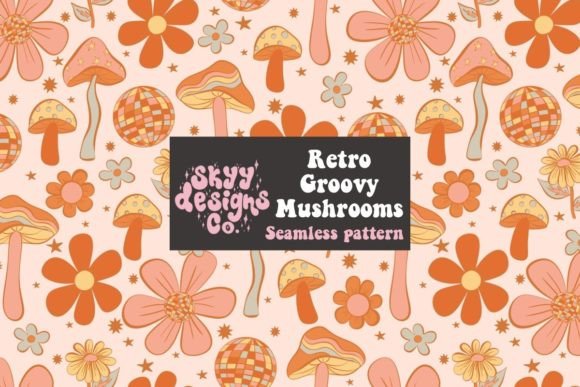
A Retro Groovy Mushroom Seamless Pattern is a digitally designed, tileable artwork featuring stylized mushrooms rendered in mid-century modern and 1970s-inspired aesthetics—think bold outlines, warm earth tones, swirling stems, polka-dotted caps, and subtle sunburst or paisley accents. The “seamless” quality means the pattern repeats smoothly edge-to-edge without visible breaks or misalignments, making it suitable for continuous surface coverage across digital and print applications.
This specific offering from Skyy Designs Co. delivers one high-resolution JPEG file: 12×12 inches at 300 DPI. It is intended as a ready-to-use asset—not a customizable template or layered source file—and functions as a single-repeat tile optimized for consistency and clarity at standard print sizes.
Why Consider This Pattern?
Designers, crafters, and small-business owners often seek patterns that convey personality while maintaining technical reliability. The Retro Groovy Mushroom Seamless Pattern appeals to those aiming to evoke nostalgia, playfulness, or organic warmth without leaning into overly literal or contemporary botanical styles. Its retro sensibility bridges vintage charm and modern usability—particularly useful for branding elements, textile mockups, stationery, or web backgrounds where thematic cohesion matters.
Interest may arise when a project calls for visual continuity across multiple touchpoints (e.g., packaging, social media banners, and fabric swatches) and when time or licensing constraints limit the use of custom illustration or subscription-based pattern libraries.
Practical Benefits and Realistic Expectations
The primary benefit lies in its immediacy and fidelity: a single 12×12 inch, 300 DPI JPEG provides sufficient resolution for most print-on-demand services and standard desktop publishing workflows. Because it’s delivered as a flattened JPEG, users avoid compatibility issues with layered formats (e.g., PSD or AI files requiring specific software), and the seamless repeat is pre-tested—no manual tiling adjustments are needed for basic implementation.
However, expectations should be grounded. As a JPEG, the pattern cannot be recolored non-destructively; any hue shifts require raster editing tools and may affect detail clarity. It also lacks vector scalability: enlarging beyond its native dimensions risks pixelation, especially in large-format prints like wall murals or signage. Users needing flexibility in scale, color variation, or editable components (e.g., individual mushroom elements) will find this format limiting.
When This Pattern Is a Strong Fit
This asset works well for projects with defined scope and output parameters. For example:
- Small-batch product design: Applying the pattern to greeting cards, notebook covers, or tote bag mockups where 12×12 inches matches common print templates.
- Digital branding support: Using it as a subtle background layer in presentations, email headers, or social media story frames—especially when retro tone supports brand voice.
- Educational or hobbyist use: Students learning about repeat patterns, designers prototyping layout ideas, or makers testing fabric or paper prints before committing to larger runs.
- Licensing simplicity: Skyy Designs Co. typically offers straightforward personal and commercial licenses for their seamless patterns—ideal when clarity around usage rights is prioritized over granular control.
In each case, the user values speed, visual cohesion, and predictable results over deep customization or extreme scalability.
When Alternatives May Be More Appropriate
Consider other options if your workflow demands:
- Vector-based flexibility: If you need to resize infinitely, isolate elements, or adapt colors programmatically, a vector pattern (e.g., SVG or EPS) would better serve long-term reuse—even if initial setup takes longer.
- Multicolor or theme variants: A single JPEG offers only one fixed palette. Projects requiring coordinated variations (e.g., light/dark modes, seasonal palettes) may benefit from pattern bundles or editable source files.
- Large-scale physical output: For murals, trade show graphics, or wallpaper, a higher-resolution TIFF or multi-tile vector layout may be necessary to preserve sharpness at scale.
- Integration with design systems: Teams managing consistent assets across platforms may prefer patterns embedded in Figma libraries or CSS-compatible formats rather than standalone JPEGs.
Making an Informed Decision
To determine whether the Retro Groovy Mushroom Seamless Pattern aligns with your needs, ask three practical questions:
- What is my primary output medium? If it’s standard print products (e.g., 8.5×11 inch flyers, 12×12 inch fabric panels) or digital interfaces with moderate resolution requirements, the 300 DPI JPEG meets typical thresholds. If not, verify resolution suitability against your printer’s or platform’s specifications.
- How much editing do I anticipate doing? If color tweaks, cropping, or element isolation are essential, factor in the time required to manipulate a flattened raster file versus sourcing a more flexible format.
- What is my usage context? Review the license terms provided by Skyy Designs Co. Ensure permitted uses match your intended application—especially for client work or resale products where attribution or sublicensing restrictions may apply.
Also consider how this pattern compares functionally—not just stylistically—to others in your shortlist. Two patterns may share similar motifs, but differences in tile size, DPI, file type, or licensing can significantly impact integration effort and final quality. Testing a low-resolution preview (if available) on your target canvas helps assess visual density and repeat behavior before purchase.
Final Considerations
Seamless patterns are functional tools first. While aesthetic appeal matters, evaluating them through the lens of technical fit ensures smoother execution later. The Retro Groovy Mushroom Seamless Pattern serves a distinct niche: those who value curated retro styling paired with out-of-the-box usability. It is neither a universal solution nor a substitute for custom illustration—but within its intended scope, it delivers consistent, on-brand repetition with minimal overhead.
If your goals center on efficient implementation for mid-size print or digital projects—and you’re comfortable working within the constraints of a high-res JPEG—the pattern offers reliable performance. If your needs extend beyond those boundaries, exploring scalable, editable, or multi-format alternatives remains a reasonable next step.