Why Christmas Glitter Digital Paper Is Reshaping Creative Production for Professionals
For professionals who design invitations, craft digital stationery, build branded holiday campaigns, or produce print-on-demand products, Christmas Glitter Digital Paper has evolved from a seasonal novelty into a strategic creative asset. No longer just decorative filler, it’s now a high-fidelity, production-ready resource that bridges aesthetic intention with operational efficiency—especially in fast-paced, deadline-driven workflows.
What Exactly Is Christmas Glitter Digital Paper?
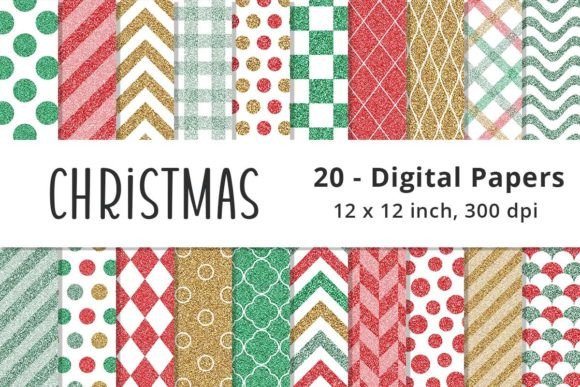
Christmas Glitter Digital Paper refers to professionally designed, high-resolution raster image files (typically JPG) that simulate the visual texture and luminosity of physical glitter paper—but optimized for digital use. Unlike generic holiday patterns or low-res clipart, premium sets—like the 20 Red, Green and Gold Christmas Glitter Digital Papers—are crafted with intentional color harmony, realistic light reflection, and consistent scale. Each file is 12 x 12 inches at 300 dpi, meeting industry standards for both screen presentation and professional printing.
Crucially, these are flattened raster files, not vectors. That distinction matters: while vectors excel in scalability and editing flexibility, raster-based glitter papers deliver photorealistic depth, subtle grain, and nuanced metallic sheen—qualities difficult to replicate convincingly in vector form. The included patterns—Polka Dot, Chevron, Stripes, Gingham, Plaid, and more—are not mere repeats; they’re rhythmically balanced, proportionally calibrated, and intentionally saturated to retain vibrancy across devices and substrates.
A Response to Shifting Creative Demands
The rise of Christmas Glitter Digital Paper reflects deeper shifts in how professionals approach seasonal design. Consider three converging trends:
- Accelerated Content Cycles: With social media timelines, email marketing calendars, and e-commerce product launches compressing holiday campaign windows, creators need assets that work immediately—not after hours of layering, masking, or color correction. These 20 digital papers eliminate the “glitter gap”: the time traditionally spent sourcing textures, adjusting blending modes, or troubleshooting print-safe metallics.
- Brand Consistency Across Touchpoints: A luxury boutique launching holiday gift cards, Instagram story templates, and printable packaging inserts needs visual cohesion without sacrificing nuance. Red, green, and gold aren’t just colors—they’re tonal anchors. This set delivers coordinated variations (e.g., a subtle gold chevron alongside a bold red gingham), enabling designers to maintain brand voice while varying emphasis, hierarchy, and format.
- Hybrid Production Workflows: Freelancers and small studios increasingly toggle between digital delivery (PDF invites, Canva templates) and physical output (letterpress stationery, foil-stamped packaging). Raster files at 300 dpi ensure fidelity whether viewed on an iPad or printed on textured cardstock—no interpolation artifacts, no color bleed, no guesswork.
Where It Fits in Today’s Creative Ecosystem
This isn’t about nostalgia for craft supplies—it’s about precision in execution. In 2024, Christmas Glitter Digital Paper occupies a deliberate niche between stock photography and custom illustration: it offers the speed of stock with the intentionality of bespoke design.
For marketers building holiday email sequences, a gold polka dot background adds tactile warmth to a minimalist layout—boosting engagement without cluttering the message. For scrapbookers producing client albums, these papers provide archival-grade texture that holds up under layering, journaling, and photo overlays. For entrepreneurs launching limited-edition greeting cards, using a consistent glitter pattern across front, back, and envelope liner creates perceived value—before the recipient even opens the package.
Technologically, this reflects broader adoption of asset-first design systems. Rather than starting from blank canvases, professionals curate libraries of purpose-built components—typography pairings, icon sets, and now, texture libraries like this collection. It’s a move away from reactive creation toward proactive composition.
Practical Integration: Beyond Decoration
These 20 digital papers function as foundational layers—not just embellishments. Here’s how forward-thinking users apply them:
- Backgrounds with Depth: Used beneath transparent text or logo lockups, the glitter texture prevents visual flatness while retaining readability—especially important for accessibility-compliant contrast ratios.
- Masking & Layering: Designers import files into Photoshop or Affinity Photo, then use them as clipping masks for gradients, typography, or illustrations—transforming static elements into dynamic, seasonally resonant compositions.
- Print-Ready Templates: Bundled into Canva, Adobe Express, or Figma template kits, these papers serve as base layers for clients to personalize—ensuring brand-aligned outputs without requiring design expertise.
- SVG & Web Use (with adaptation): While raster-based, the 12×12 size allows clean cropping into web-optimized dimensions (e.g., 1920×1080 hero banners or 1080×1080 social tiles), preserving glitter integrity at common display resolutions.
Why Red, Green, and Gold—Not Just Any Palette?
This trio isn’t arbitrary. It’s rooted in both cultural resonance and chromatic reliability. Red communicates energy and urgency—critical for limited-time offers. Green signals growth, harmony, and sustainability—increasingly central to consumer expectations around ethical gifting. Gold conveys premium quality and timeless elegance, performing consistently across print and screen where metallic inks or foils would fail.
Importantly, these hues were calibrated for cross-device accuracy. The red avoids oversaturation on OLED screens; the green maintains richness on matte paper stocks; the gold retains luminosity without veering into yellow or brown under varied lighting conditions. That level of color intelligence separates utility from decoration.
Workflow Efficiency Meets Creative Integrity
One overlooked benefit of using a cohesive set like the 20 Red, Green and Gold Christmas Glitter Digital Papers is reduction in decision fatigue. When every element—from background to border—is part of an intentional system, designers spend less time debating “Does this stripe clash?” and more time refining messaging, structure, and user experience.
Consider a freelance graphic designer delivering holiday branding assets to a midsize retailer. Instead of sourcing disparate textures from multiple marketplaces (risking inconsistent DPI, mismatched color profiles, or licensing ambiguity), they deploy one trusted set—verified for commercial use, pre-sized, and visually unified. That saves roughly 3–5 hours per project—time reinvested in strategy, client consultation, or portfolio development.
Similarly, educators creating printable classroom resources—or nonprofit teams designing year-end donor reports—gain immediate polish without requiring advanced software skills. The flattened JPG format ensures compatibility across platforms: Windows, macOS, ChromeOS—even tablets running lightweight editors.
Looking Ahead: Texture as Strategic Language
As generative tools accelerate layout generation and AI assists with color matching, the demand for human-curated texture libraries is growing—not shrinking. Algorithms can mimic glitter, but they struggle with contextual appropriateness: knowing when a delicate gold gingham supports sophistication versus when a bold red chevron drives celebration. That discernment comes from experience—and from resources built by practitioners, for practitioners.
Christmas Glitter Digital Paper represents more than seasonal aesthetics. It’s evidence of a maturing digital craft—one where texture, resolution, color science, and workflow pragmatism converge. Whether you’re scaling a holiday product line, supporting community arts initiatives, or elevating client deliverables, this set delivers measurable ROI: in time saved, consistency achieved, and perception elevated.
Because in today’s creative economy, the most valuable assets aren’t just beautiful—they’re built for action.