Abstract Spheres: A Versatile Visual Language for Modern Design and Communication
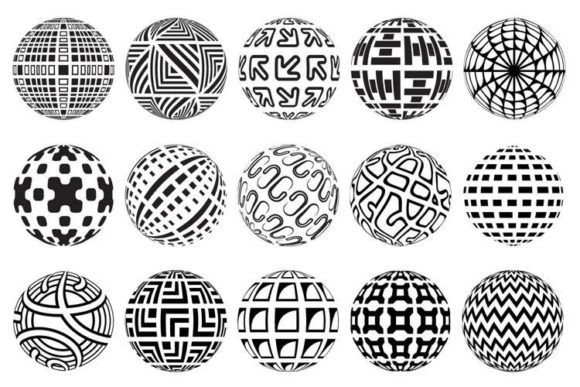
Abstract Spheres represent more than a stylistic motif—they embody a foundational visual language rooted in geometry, contrast, and dimensional perception. At their core, these are not mere decorative circles, but carefully crafted 3D-rendered ball shapes that merge mathematical precision with expressive abstraction. Defined by high-fidelity black and white patterns—ranging from fractal-like tessellations and optical moiré effects to organic stippling and algorithmic line work—each sphere carries visual weight, spatial depth, and conceptual resonance. Unlike flat icons or generic stock graphics, Abstract Spheres leverage photorealistic lighting, subtle surface curvature, and intentional tonal gradation to evoke tactility and presence—even in monochrome.
Why Black and White Patterns Elevate Dimensional Clarity
The deliberate restriction to black and white is not an aesthetic limitation—it’s a strategic design decision. Without chromatic distraction, the viewer’s attention focuses entirely on form, rhythm, and spatial hierarchy. High-contrast patterning enhances the perception of volume: concentric rings suggest rotation; radial gradients imply light falloff; asymmetric line densities create implied axis tilt. In 3D rendering, this contrast translates directly into stronger shadow definition, sharper edge acuity, and more convincing surface topology. For example, a sphere rendered with tightly spaced parallel lines angled at 45° reads as both static and dynamic—its pattern appears to shift subtly under imagined ambient light, reinforcing its three-dimensionality.
This clarity serves functional ends across disciplines. Educators use such spheres to demonstrate principles of perspective, symmetry, and light modeling without requiring color theory foundations. Researchers studying visual cognition have observed that high-contrast monochrome stimuli elicit faster pattern recognition and improved retention in spatial reasoning tasks. Designers rely on them to anchor layouts where color palettes must remain flexible—such as brand guidelines with strict accessibility requirements or multilingual interfaces needing universal legibility.
File Format Diversity Meets Real-World Workflow Needs
A robust collection of Abstract Spheres isn’t defined solely by visual quality—but by technical adaptability. The included asset suite—15 high-resolution JPGs (300 ppi), 15 transparent-background PNGs (300 ppi), 15 scalable SVGs, 15 editable AI files, and 15 EPS 10 vector versions—ensures seamless integration across every stage of production.
- JPG files provide immediate usability for web publishing, presentations, and print-ready layouts where background context is fixed. Their 300 ppi density guarantees crisp reproduction even in large-format signage or exhibition panels.
- PNG files unlock flexibility in layered compositions—ideal for UI mockups, digital illustrations, or motion graphics where spheres must sit atop gradients, photographs, or animated backgrounds without haloing or compression artifacts.
- SVG files scale infinitely without degradation, making them indispensable for responsive websites, interactive dashboards, and embedded infographics. Because they’re code-based, developers can manipulate individual pattern elements via CSS or JavaScript—for instance, animating stroke opacity to simulate pulsing depth or toggling pattern density on hover.
- AI and EPS files preserve full vector editability: designers can adjust stroke weights, reposition pattern modules, recolor individual layers (even if originally black/white), or isolate segments for custom compositing. This matters deeply when adapting assets for branded merchandise, technical schematics, or accessible variants—such as converting a dense dot pattern into a larger, lower-frequency texture for low-vision users.
This multi-format support reflects how Abstract Spheres function not as static images, but as modular visual components. A single sphere might begin life as an SVG in a Figma design system, be exported as a PNG for a client pitch deck, then repurposed as a vector EPS for laser-cut acrylic signage—all while retaining structural integrity and visual fidelity.
Practical Applications Across Diverse Fields
Abstract Spheres thrive where conceptual abstraction meets concrete utility. Their versatility emerges most clearly when observed in action—not as isolated assets, but as integrated tools solving real problems.
In architectural visualization, designers embed subtle Abstract Spheres into material swatch libraries to indicate surface reflectivity or texture variation—replacing vague labels like “matte” or “glossy” with instantly legible visual cues. A sphere with fine cross-hatching suggests brushed metal; one with broad, sweeping arcs evokes polished stone. These aren’t decorative flourishes—they reduce miscommunication between architects, contractors, and clients during specification reviews.
Educational technology platforms use them as interactive learning anchors. In physics simulations, a rotating Abstract Sphere with polar grid lines helps learners visualize angular momentum vectors. In mathematics curricula, spheres segmented by Voronoi patterns introduce partitioning concepts before students encounter formal notation. Because all 15 variations maintain consistent proportions and lighting logic, instructors can build progressive lessons—starting with basic silhouette recognition and advancing to pattern-based inference—without visual inconsistency undermining pedagogical scaffolding.
For brand identity systems, Abstract Spheres serve as scalable, non-literal brand marks. Unlike literal logos (e.g., a coffee cup for a café), they convey values—balance, unity, complexity, or innovation—without locking the brand into narrow associations. A fintech startup might select a sphere with interlocking geometric bands to imply security and interconnectedness; a wellness app may choose one with soft, flowing wave patterns to suggest harmony and flow. Crucially, because each format supports precise alignment and consistent scaling, the same sphere works equally well as a favicon, app icon, presentation header, and trade show backdrop.
Even in data visualization, these spheres transcend ornamentation. When mapped to multidimensional datasets—say, representing nodes in a network graph—their size encodes magnitude, their pattern density reflects data confidence intervals, and their rotational orientation signals directional relationships. This transforms abstract metrics into perceptually grounded forms, lowering cognitive load for analysts interpreting complex systems.
Design Integrity and Technical Considerations
Working effectively with Abstract Spheres requires attention to contextual harmony—not just technical compatibility. First, lighting consistency matters: if integrating multiple spheres into a single composition, ensure their highlight positions and shadow angles align with a shared virtual light source. Mixing spheres rendered with top-left versus bottom-right illumination creates visual dissonance, undermining the illusion of shared space.
Second, pattern scale must relate meaningfully to surrounding elements. A densely patterned sphere may dominate a minimalist interface unless its physical size is reduced proportionally—or its pattern simplified via vector editing. Conversely, overscaling a low-frequency pattern risks pixelation in raster formats or awkward spacing in vector exports. The provided 300 ppi resolution and native vector scalability mitigate these issues, but intelligent application remains essential.
Third, consider semantic resonance. Not all black-and-white patterns communicate equally. A chaotic, high-entropy pattern may signal complexity or disruption—ideal for innovation-focused contexts—but feel jarring in healthcare or education settings where calm, predictability, and clarity are paramount. Thoughtful selection—guided by audience expectations and message intent—is part of the design process, not an afterthought.
Future-Proofing Through Abstraction
As design systems evolve toward greater modularity and AI-assisted generation, Abstract Spheres offer inherent resilience. Their lack of literal referents means they avoid rapid obsolescence tied to cultural trends or technological fads. A sphere with recursive triangular tiling remains conceptually relevant whether deployed in a 2024 SaaS dashboard or a 2030 spatial computing interface—because it speaks to enduring human perceptions of order, symmetry, and depth.
Moreover, their foundation in rigorous 3D rendering ensures compatibility with emerging pipelines. These assets import cleanly into WebGL environments, function as texture sources in Unity or Unreal Engine projects, and serve as training references for generative AI models focused on geometric coherence. The inclusion of EPS 10—a widely supported vector standard—further guarantees longevity across software generations, unlike proprietary or version-locked formats.
Ultimately, Abstract Spheres succeed not by chasing novelty, but by anchoring innovation in timeless visual principles. They are tools shaped by craft, tested through application, and refined for purpose—offering professionals across fields a shared vocabulary for expressing dimension, contrast, and conceptual weight without reliance on transient aesthetics or restrictive semantics.