Christian Digital Papers: Purposeful Design for Meaningful Communication
Christian digital papers are not decorative add-ons—they’re strategic assets. When grounded in intention, these files support clarity of message, consistency of voice, and alignment with deeply held values. Whether you're designing a faith-based curriculum, launching a ministry newsletter, building a devotional app interface, or crafting printed materials for a church event, the visual language you choose shapes how people receive, remember, and respond to your content. Christian digital papers—curated as SVG, PNG, JPG, PDF, and transparent PNG formats—offer a cohesive, high-resolution foundation for that work.
Why Resolution and Format Flexibility Matter Strategically
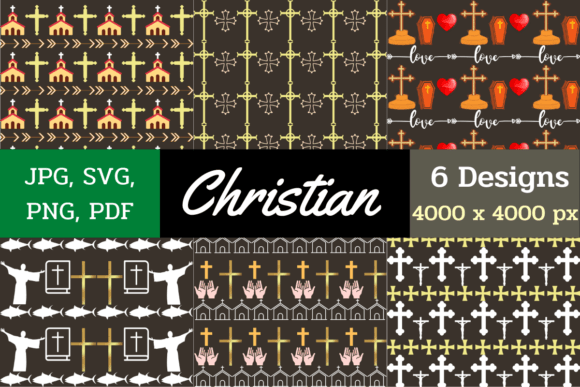
Each file in this collection is sized at 4000 x 4000 pixels—a deliberate choice. That resolution ensures sharp rendering across print (brochures, banners, letterhead) and digital (websites, social posts, email headers, presentation slides). But resolution alone isn’t enough. The value lies in format diversity:
- SVG files scale infinitely without quality loss—ideal for logos, icons, or responsive web elements where crispness must hold at any size;
- PNG and transparent PNG files preserve layered detail and clean edges—critical when overlaying patterns onto photos, video backgrounds, or branded templates;
- JPG files offer broad compatibility and smaller file sizes—practical for fast-loading web galleries or email-safe graphics;
- PDF files maintain typographic integrity and vector fidelity—useful for print-ready layouts, editable sermon handouts, or multi-page devotionals.
This isn’t about having “more files.” It’s about reducing friction between idea and execution. When you need to adapt one design across five delivery channels—and do it without reworking proportions, losing transparency, or compromising legibility—the right format mix saves time, preserves intent, and strengthens consistency.
Intentional Use Starts With Clarity of Purpose
Before opening a file, ask: What outcome am I trying to support? A Christian pattern used on a children’s Bible study worksheet serves a different function than the same pattern applied to a nonprofit’s annual report cover. One invites engagement; the other conveys stewardship and credibility. Using Christian digital papers thoughtfully means matching format, scale, and visual tone to audience context—not just aesthetic preference.
For example:
- An educator preparing printable lesson plans might rely heavily on the PDF and PNG transparent files—ensuring text overlays remain legible and branding stays consistent across dozens of handouts;
- A small business owner launching a faith-integrated product line may use SVGs for scalable website icons and JPGs for Instagram carousel posts—prioritizing speed and recognition over editability;
- A freelance designer building a client’s worship app interface could layer transparent PNGs over gradient backgrounds, then export final screens as high-res JPGs for developer handoff—keeping workflow tight and output precise.
In each case, the asset isn’t the end goal—it’s an enabler of a larger objective: teaching more effectively, communicating authenticity, or delivering polished user experiences.
Editing Without Compromise: What “Easy to Modify” Really Means
The phrase “you can easily edit these files” holds weight only if the files are built for modification—not just labeled as such. These Christian digital papers are structured to support real-world editing workflows:
- PNG and JPG files retain full color depth and anti-aliased edges—no pixelation when resizing or adjusting brightness/contrast in Photoshop or Canva;
- SVG files contain clean, named layers—allowing designers to isolate and recolor individual elements (e.g., changing a cross motif from gold to navy without affecting the background texture);
- PDF files are flattened but retain vector paths—making them safe for print while still allowing text replacement in Adobe Acrobat or Illustrator;
- Transparent PNGs use alpha channels correctly—so they drop cleanly onto any background without haloing or edge artifacts.
This level of technical readiness reduces trial-and-error. It means less time troubleshooting exports and more time refining messaging, testing layouts, or iterating based on feedback.
Risks of Using Christian Patterns Without Strategic Anchoring
Even high-quality assets can dilute impact—if deployed without context. Common missteps include:
- Overloading visuals: Applying multiple Christian patterns across one page or slide competes for attention and obscures hierarchy—especially in digital spaces where users scan, not read;
- Ignoring accessibility: High-contrast patterns may interfere with text legibility for readers with low vision—always test foreground/background combinations against WCAG contrast ratios;
- Mismatched tone: A highly ornate, baroque-style Christian pattern may feel incongruent with a modern, minimalist youth ministry brand—visual cohesion requires alignment with voice, audience expectations, and platform norms;
- Assuming universality: Symbols carry layered meaning across denominations and cultures—what reads as reverent in one context may feel exclusionary in another. Consider symbolism deliberately, not decoratively.
These aren’t limitations of the files themselves—they’re reminders that tools serve strategy, not replace it.
Planning Your Integration: A Practical Framework
Start small. Identify one upcoming project where visual consistency matters—perhaps a quarterly newsletter, a new landing page, or a set of workshop handouts. Then apply this three-step filter:
- Goal check: What action should the viewer take? (e.g., register, reflect, share, donate) Does the pattern support or distract from that action?
- Format match: Which file type best suits the output channel? (e.g., SVG for a responsive header logo, transparent PNG for a social media quote graphic)
- Adaptation plan: What minimal edits will ensure relevance? (e.g., swapping a color to match existing brand guidelines, cropping to fit a specific aspect ratio, pairing with accessible typography)
This approach treats Christian digital papers as part of a system—not isolated elements. It also builds confidence. Once you’ve successfully adapted one file for a real use case, scaling to others becomes iterative, not intimidating.
Long-Term Value: Beyond the Download
The zip package contains 30 files—but its real utility compounds over time. As your needs evolve, so does your ability to repurpose these assets:
- Reuse SVG motifs as animated loading icons in web apps;
- Convert PDF devotionals into interactive flipbooks for tablet use in counseling sessions;
- Layer transparent PNG textures over video thumbnails to reinforce thematic continuity across a YouTube series;
- Extract color palettes from JPG files to inform future brand extensions or merch design.
That longevity depends on two things: technical quality (which this collection delivers) and disciplined reuse. Keep a simple spreadsheet tracking where each pattern has been applied, what edits were made, and what outcomes followed. Over six months, you’ll begin seeing patterns in your own patterns—revealing which visual choices consistently strengthen connection, clarity, or conversion.
Getting Started: Practical Next Steps
You don’t need to use all 30 files at once—or even in the same year. Begin with what aligns most directly with your current priority:
- If launching a new website: start with the SVG files for navigation icons and the transparent PNGs for hero section overlays;
- If preparing printed materials: open the PDF and JPG files first—test print one page to verify color accuracy and sharpness;
- If designing social content: use the PNG transparent files to build reusable templates in Canva or Figma—then save those as brand-approved presets.
And remember: unzipping is step zero—not step one. Install WinZip, WinRAR, or a native OS archive tool before downloading. A stalled extraction process shouldn’t delay your progress.
Christian digital papers, at their best, help you communicate with greater intention, produce with greater efficiency, and represent your mission with greater fidelity. They won’t replace thoughtful planning—but they will make that planning easier to execute, extend, and sustain.