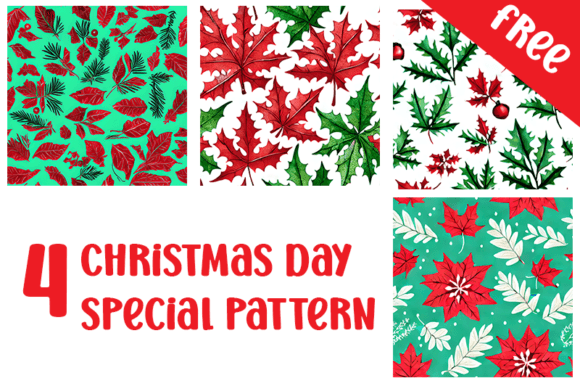
Special Pattern on Christmas Day
Imagine a design that doesn’t just say “Christmas” — but feels like the quiet magic of December morning light filtering through frosted glass, or the precise joy of wrapping a gift with care. That’s the essence of the Special Pattern on Christmas Day: a 4096×4096 px, 72 dpi PNG file built for versatility and visual impact. It’s not a single motif — it’s a thoughtfully layered composition where symmetry meets surprise, tradition meets modern restraint, and repetition invites discovery.
Why This Pattern Stands Out
Unlike generic snowflakes or predictable wreaths, this pattern integrates four distinct yet harmonious motifs — each designed to function independently *or* interlock seamlessly. The result is a high-resolution tileable background that holds up at any scale: whether printed full-wall in a boutique café, scaled down as a subtle watermark on digital gift cards, or repeated across fabric for limited-edition holiday packaging. Its 72 dpi resolution ensures crisp rendering on screens without bloating file size — ideal for email newsletters, social banners, or web overlays where speed and clarity matter.
Four Special Patterns — And How They Work Together
At its core, the Special Pattern on Christmas Day draws strength from four complementary elements:
- Frosted Geometric Frame — A delicate border of intersecting hexagons and softened diamonds, evoking ice crystals and architectural precision. Perfect as a framing device for photo collages or printable greeting cards.
- Minimalist Evergreen Cluster — Three stylized pine sprigs arranged in gentle rotation. Not botanical, not cartoonish — just clean, balanced, and scalable. Use it solo on labels, stitched onto linen napkins, or as repeating icons in a digital advent calendar.
- Woven Ribbon Motif — A continuous line that loops, crosses, and tucks — suggesting ribbon, garland, or even circuitry. Ideal for tech-adjacent brands wanting warmth without cliché, or educators designing interactive holiday lesson slides.
- Starlight Dot Grid — A subtle, off-kilter constellation of varying-sized dots, spaced to avoid rigidity. Works invisibly beneath text overlays or as a tactile texture when printed on uncoated paper.
None dominates. None feels forced. Together, they create rhythm — not noise.
Real Applications, Not Just Ideas
You don’t need a design degree to use this well. Here’s how different creators are applying it — right now:
- Small business owners use the Frosted Geometric Frame as a consistent header across Etsy listings and Instagram Stories — reinforcing brand recognition without changing fonts or colors.
- Educators extract the Minimalist Evergreen Cluster to build printable behavior charts or classroom door decorations — simple enough for students to color, elegant enough for display.
- Freelance marketers layer the Starlight Dot Grid beneath bold white typography in email banners — adding depth without competing for attention.
- Print-on-demand designers combine the Woven Ribbon Motif with custom names or dates, turning the pattern into personalized ornaments or keepsake gift tags.
The key isn’t complexity — it’s intention. Each motif was built to be isolated, recolored (via PNG transparency), or repositioned without breaking cohesion.
Practical Tips for Best Results
High-res doesn’t mean high-effort. Keep these in mind:
- Test contrast early. If using over photos or textured backgrounds, try the pattern at 15–30% opacity first. Its strength lies in subtlety — not dominance.
- Respect the grid. At 4096×4096 px, it tiles cleanly. But if cropping for social media, align cuts to natural breaks — like the space between Evergreen Clusters — to avoid visual hiccups.
- Adapt color, not shape. The motifs were designed in neutral tones (ivory, charcoal, soft sage) for easy recoloring in tools like Figma, Canva, or Photoshop. Avoid altering proportions — the balance is intentional.
- Think beyond “holiday.” Strip the red and green, shift to clay and oat, and the same pattern reads as artisanal, seasonal, or even editorial — extending its shelf life past December 25.
For Designers and Non-Designers Alike
If you’re comfortable in design software, explore blending modes: Multiply for rich overlays on light surfaces, Screen for ethereal lifts on dark ones. If you’re not — stick to Canva’s “Upload Background” tool or PowerPoint’s “Format Background > Picture or Texture Fill.” The PNG’s transparency means no white boxes, no jagged edges, no guesswork.
And if you're sharing this with a team? Name layers clearly (“Frame,” “Sprig,” “Ribbon,” “Dots”) before exporting variations. Consistency multiplies impact — especially when used across email, web, and print.
More Than Decoration — A Design Anchor
The Special Pattern on Christmas Day works because it serves a role: it’s a foundation, not a flourish. It gives structure to spontaneity — whether you’re launching a holiday campaign, updating your portfolio site, or prepping a workshop handout for creative professionals.
It rewards attention but doesn’t demand it. You can hang it full-scale behind a speaker at an event and guests will feel the season — not read a manual to understand it. You can shrink it to 200×200 px for a favicon and still recognize its quiet confidence.
That balance — between detail and clarity, tradition and freshness, craft and usability — is why it’s resonating across disciplines. Designers appreciate its technical integrity. Marketers value its adaptability. Educators rely on its calm authority. And hobbyists love that it looks handmade, even when it’s perfectly aligned.
So whether you’re printing 500 gift boxes for your ceramic studio, building a landing page for a winter pop-up, or illustrating a children’s ebook about holiday traditions — start here. Not with a blank canvas, but with a pattern that already understands rhythm, restraint, and the quiet weight of meaning.
Use it as-is. Remix one motif. Build a system around two. Or let all four breathe together — spacious, considered, and unmistakably yours.