Vintage Mandala Patterns for Real-World Creative Work
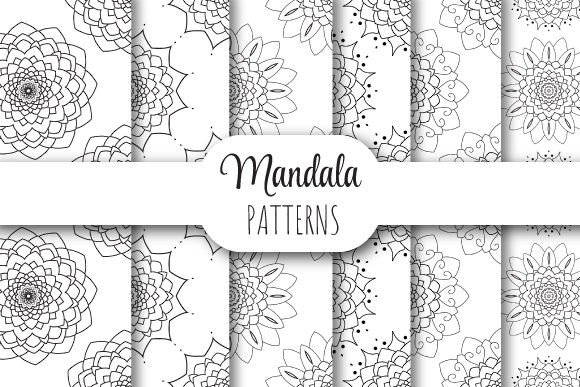
When you hear “Vintage Mandala,” think less about dusty museum archives and more about rich, hand-drawn symmetry with soul—ornate circles layered with botanical flourishes, Art Nouveau curves, subtle ink textures, and a gentle, time-worn warmth. These aren’t just decorative shapes; they’re ready-to-use design assets built for purpose. Each pattern in this collection is a seamlessly repeating vector, meaning it tiles perfectly edge-to-edge without visible breaks—ideal when you need consistent coverage across large surfaces or repeated applications.
Where Vintage Mandala Patterns Actually Get Used (Not Just Saved)
Designers, crafters, and small business owners often download patterns like these expecting inspiration—and end up using them in surprisingly practical ways. Here’s where they show up most:
- Custom stationery & wedding branding: A Vintage Mandala pattern adds quiet elegance to envelope liners, save-the-date cards, or foil-stamped menus. Because it repeats seamlessly, you can scale it to fit any card size—or even wrap it around a 12-inch square invitation suite without distortion.
- Textile and surface design: Print-on-demand creators use these files to mock up scarves, tote bags, or ceramic mugs. The 3600 × 3600 pixel JPEGs give crisp previews at actual product size, while the EPS file ensures clean scaling for production files sent to printers.
- Wallpaper and interior visuals: Interior designers drop the pattern into mood boards or client presentations as a wallpaper swatch. At 12 × 12 inches and 300 dpi, it renders accurately on high-res screens and prints cleanly for physical samples—even when zoomed in on a textured wall mockup.
- Branded packaging and labels: Small-batch makers (think artisan tea, handmade soap, or specialty candles) layer the pattern behind product names or use it as a subtle background on sticker labels. Its vintage tone conveys craftsmanship without shouting.
- Digital backdrops and social templates: Content creators repurpose the JPEGs as Instagram Story backgrounds or Zoom virtual backdrops—especially the softer, lower-contrast variants that keep focus on the speaker while adding visual interest.
Who Benefits—and How Their Needs Differ
A graphic designer preparing a client pitch has different priorities than a hobbyist embroiderer scanning for stitch guides. That’s why this collection includes both EPS and multiple JPEGs—not as filler, but as intentional flexibility.
The freelance designer reaches first for the EPS 10 file. It’s editable in Illustrator, scalable to billboard size without quality loss, and compatible with older studio workflows. They’ll recolor elements, isolate motifs for logos, or combine sections with other vectors—all without pixelation.
The print-on-demand seller leans on the six JPEGs. Each offers a distinct tonal variation: one with higher contrast for dark fabric, another softened for cream-colored paper, a third with slight grain for tactile authenticity. No extra editing needed—just drag, drop, and upload.
The teacher or workshop leader uses the JPEGs as printable PDFs for student handouts—say, a mandala coloring sheet scaled to fit standard letter paper, or a tiling exercise showing how the repeat works across quadrants. The resolution holds up even when photocopied.
What to Consider Before You Apply One
Even beautiful patterns need thoughtful placement. Here are real-world considerations users report again and again:
- Scale matters more than you think: A 12 × 12 inch tile looks generous on screen—but when printed at life-size on fabric or wallpaper, fine details (like delicate vine tendrils or tiny dotwork) may blur if stretched too far. Test a 4 × 4 inch crop first on your intended material.
- Color mode isn’t automatic: The JPEGs are RGB—perfect for web, screens, and many print vendors. But if you’re sending to a traditional offset printer, open the EPS in Illustrator and convert to CMYK before final export. Skipping this step can shift warm sepia tones toward muddy brown.
- “Seamless” doesn’t mean “invisible”: Some Vintage Mandala patterns include intentional texture overlays (light paper grain, faint ink bleed). That adds charm—but also means the repeat won’t vanish completely. If absolute invisibility is required (e.g., for technical textile repeats), check the pattern’s tile boundaries in Illustrator’s “Pattern Options” panel before committing.
- EPS 10 compatibility is solid—but not universal: While EPS 10 works in Illustrator CS6+, Affinity Designer, and CorelDRAW, it won’t open natively in Canva, Figma, or Procreate. Plan ahead: export needed elements as SVG or PNG from Illustrator first if those are your primary tools.
Strengths That Solve Real Problems
This collection shines where others fall short—not because it’s “fancier,” but because it anticipates workflow friction:
- No guesswork on resolution: At 3600 × 3600 pixels and 300 dpi, every JPEG matches industry standards for high-end print output—no resizing, no interpolation, no quality panic before hitting “submit.”
- One-click adaptability: Need a half-tile for a border? A quarter for a logo frame? The seamless nature means you can crop freely in Photoshop or Illustrator and still get clean edges.
- Vintage tone, not vintage limitation: These aren’t scanned antiques. They’re digitally drawn with authentic linework and balanced negative space—so they pair well with modern sans-serif type, minimalist layouts, or even neon accents without clashing.
Where It Might Not Fit (And That’s Okay)
These Vintage Mandala patterns excel in contexts that value warmth, intentionality, and tactile nuance—but they’re not universal. For example:
- They’re not ideal for ultra-minimalist tech branding where geometric precision or monoline simplicity is core to identity.
- If your project demands dynamic animation (e.g., looping SVG backgrounds), the static JPEGs and EPS won’t help—though you could trace key motifs in After Effects as starting points.
- For mass-market apparel with tight color constraints (e.g., four-color process only), the subtle gradients and blended tones in some JPEGs may require manual simplification.
None of that diminishes their usefulness—it just helps you match the right tool to the job. And when the job calls for quiet sophistication, hand-informed rhythm, and reliable technical specs, a Vintage Mandala pattern isn’t just decorative. It’s functional infrastructure for thoughtful design.