Motorcycle Digital Papers
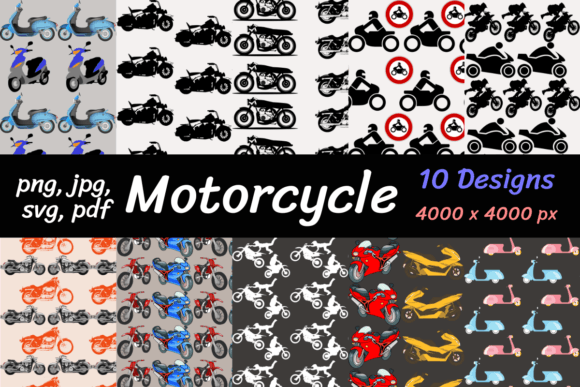
Motorcycle digital papers refer to a curated collection of high-resolution, ready-to-use motorcycle-themed design assets. These files are intended for personal or commercial creative projects—such as custom apparel, wall art, social media graphics, vinyl decals, or print-on-demand products. Unlike physical prints or stock photos, motorcycle digital papers are delivered as downloadable digital files, offering flexibility in editing, scaling, and application.
The collection includes five distinct file formats: PNG, transparent PNG, JPG, SVG, and PDF. Each format serves a specific purpose depending on how the user plans to edit or deploy the design. There are 10 unique designs per format, totaling 50 files. All images are rendered at 4000 × 4000 pixels—ensuring clarity even when enlarged for large-format printing or layered into complex design workflows.
Why Consider Motorcycle Digital Papers?
Individuals who appreciate motorcycles often seek ways to express that passion visually. Whether designing a custom helmet decal, branding a small garage business, or creating themed stationery, having access to professionally crafted, consistent motorcycle patterns saves time and improves output quality. Motorcycle digital papers provide a cohesive visual language—featuring motifs like silhouettes, vintage badges, tire treads, or minimalist line art—that can unify a project’s aesthetic without requiring illustration skills.
For designers, educators, or hobbyists, these files serve as foundational elements rather than finished products. Their versatility supports iterative experimentation: resizing an SVG without pixelation, layering transparent PNGs over photographs, or embedding vector paths into CAD software for CNC cutting.
Understanding Format Differences and Use Cases
Each file type offers distinct advantages and limitations:
- PNG files preserve sharp edges and support basic transparency (e.g., white backgrounds removed), making them ideal for web use or quick mockups where resolution matters more than scalability.
- Transparent PNG files go further by removing all background layers—including subtle shadows or gradients—allowing seamless integration over any color or texture. These work well for stickers, overlays, or layered digital collages.
- JPG files offer smaller file sizes and broad compatibility but do not support transparency. They suit photo-based presentations, email attachments, or platforms with strict upload limits.
- SVG files are vector-based, meaning they scale infinitely without quality loss. They’re optimal for laser engraving, embroidery digitizing, or responsive web design—but require vector-editing tools (e.g., Adobe Illustrator or Inkscape) for modification.
- PDF files maintain layout fidelity and embed fonts or multi-page instructions. They’re useful for print-ready documents, technical guides, or sharing static previews across devices.
Users should assess their workflow before selecting which formats to prioritize. A graphic designer building a brand identity may rely heavily on SVG and transparent PNGs, while a teacher preparing classroom posters might prefer JPG or PDF for simplicity.
Practical Considerations Before Downloading
These files arrive in a compressed ZIP archive. To access them, users need standard unzipping software—such as WinZip, WinRAR, or the built-in utilities found in macOS and modern Windows versions. No special licensing is required for personal use; however, those intending commercial application should review the included license terms to confirm permitted usage scope (e.g., quantity limits, attribution requirements, or resale restrictions).
Editing capability depends on both file format and software access. While JPG and PNG files can be adjusted in free tools like GIMP or Canva, SVG and PDF edits typically demand professional applications. Users unfamiliar with vector editing may find SVG files less immediately usable unless they plan only to resize or place them unchanged.
Resolution is consistently high (4000 × 4000 px), but pixel dimensions alone don’t guarantee suitability for every output. For example, large-scale outdoor signage may require additional color profile calibration or bleed margins—tasks beyond the scope of the provided files.
When Motorcycle Digital Papers Are a Strong Fit
This collection suits users who value consistency, efficiency, and creative control. It’s especially helpful when:
- You’re developing a series of related items—like matching T-shirts, mugs, and phone cases—and want uniform motorcycle motifs across formats.
- You lack illustration resources but need scalable, clean assets for prototyping or client presentations.
- You're integrating motorcycle visuals into educational materials, workshop handouts, or community event branding where recognizable, non-copyrighted imagery is essential.
- You prefer downloading once and reusing assets across multiple projects rather than sourcing new images each time.
In such cases, the bundled variety—spanning raster and vector formats—reduces dependency on external stock libraries or freelance designers.
When Alternatives May Be Worth Exploring
Motorcycle digital papers may be less suitable if:
- Your project requires highly specific imagery—such as a particular motorcycle model, year, or manufacturer logo—not represented in the set. Custom illustration or licensed photography would then be necessary.
- You need real-time collaboration features, cloud-based editing, or version history—capabilities native to online design platforms but absent from static downloads.
- You’re working under tight deadlines and lack time to learn vector-editing tools needed to modify SVGs effectively.
- Your use case involves animation, interactivity, or 3D rendering—formats outside the scope of this collection.
Free or subscription-based stock services may offer broader stylistic variety or AI-assisted customization, though often at the cost of consistent branding or long-term licensing clarity.
Making an Informed Decision
Evaluating whether motorcycle digital papers align with your needs starts with clarifying intent. Ask yourself:
- What formats does my current software support?
- Do I need transparency, scalability, or print-ready layouts—or a combination?
- How many variations do I realistically need? (The set provides 10 per format, avoiding redundancy while enabling selection.)
- Will I reuse these assets across multiple projects, justifying upfront acquisition over piecemeal purchases?
If most answers point toward reuse, consistency, and format flexibility, this collection offers measurable utility. If your goals center on one-off, highly tailored visuals—or if you already own comparable assets—the investment may offer diminishing returns.
Ultimately, motorcycle digital papers represent a practical tool—not a universal solution. Their value emerges not from novelty, but from reliability, resolution, and thoughtful format coverage. For those who regularly translate motorcycle enthusiasm into visual form, they serve as a functional foundation worth considering alongside other creative resources.